Current issue
Archive
Online-First
About the Journal
Journal Description
Aim & Scope
Editorial Boards
Abstracting/Indexing
Peer Review Policy
Archiving & Data Policy
For Authors
Authors Guidelines
Publications Ethics
Miscondact & Plagiarism
Article Processing Charge (APC)
Artifical Intelegence (AI) Policy
Contact
RESEARCH PAPER
Artificial Intelligence and International Students' Career Choices: STEM and Healthcare as Sustainable Career Pathways
1
Florida Gulf Coast University
These authors had equal contribution to this work
Submission date: 2026-08-24
Final revision date: 2026-08-28
Acceptance date: 2026-08-28
Publication date: 2026-08-29
Anatolian Journal of Educational Leadership and Instruction 2026;14(1)
KEYWORDS
STEM educationemployabilitycareer developmentinternational studentsartificial intelligencehealthcare education
TOPICS
ABSTRACT
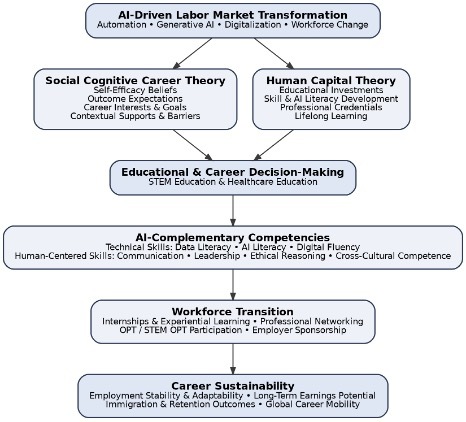
Artificial intelligence (AI) is rapidly transforming global labor markets, higher education, and workforce expectations, creating new challenges for international students’ educational planning, employability, immigration pathways, and long-term career sustainability. Guided by Social Cognitive Career Theory (SCCT) and Human Capital Theory (HCT), this integrative literature review synthesizes empirical research, workforce reports, and policy analyses to examine how AI-driven technological disruption influences educational decision-making, career development, and workforce preparedness among international students. Findings identify several emerging trends, including growing demand for AI literacy, interdisciplinary competencies, adaptability, and continuous lifelong learning. STEM and healthcare disciplines currently demonstrate comparatively strong resilience to AI-driven labor-market disruption because of projected employment growth, complementarity between professional expertise and AI technologies, and post-graduation immigration opportunities through pathways such as Optional Practical Training (OPT) and STEM OPT extensions. The review further indicates that career sustainability increasingly depends on combining advanced technical competencies with uniquely human capabilities, including critical thinking, communication, ethical reasoning, leadership, adaptability, and cross-cultural collaboration. Building on these findings, the study proposes an integrated conceptual model combining SCCT and HCT to explain how self-efficacy, outcome expectations, educational investments, and contextual factors shape career decision-making in AI-driven economies. The review also distinguishes evidence based on direct labor-market projections from insights derived from adjacent literatures and the authors’ conceptual synthesis. Practical implications are offered for higher education institutions, career services, policymakers, and international students seeking to strengthen workforce readiness, informed career decision-making, and long-term career success in an increasingly AI-enabled global economy.
REFERENCES (96)
1.
Abina, A., Temeljotov Salaj, A., Cestnik, B., Karalič, A., Ogrinc, M., Kovačič Lukman, R., & Zidanšek, A. (2024). Challenging 21st-century competencies for STEM students: Companies' vision in Slovenia and Norway in the light of global initiatives for competencies development. Sustainability, 16(3), Article 1295. https://doi.org/10.3390/su1603....
2.
Acemoglu, D., & Restrepo, P. (2019). Automation and new tasks: How technology displaces and reinstates labor. Journal of Economic Perspectives, 33(2), 3–30. https://doi.org/10.1257/jep.33....
3.
Ajuzieogu, E. (2025). Human capital investment under AI transition: Educational returns and optimal policy [Preprint]. ResearchGate. https://doi.org/10.13140/RG.2.....
4.
Al Aina, R. (2026). Bridging the AI skills gap: Preparing generation Z for the evolving job market landscape through innovative educational strategies. Industry and Higher Education. Advance online publication.
5.
Al-Motrif, A., Alfayez, A. A., Almalhy, K. M., Omar, S. A., & Alruwaili, T. (2025). Academic and technical obstacles to the shift to digital education in Saudi schools: Teachers' and experts' views. Interactive Learning Environments, 33(9), 5142–5165. https://doi.org/10.1080/104948....
6.
Althubyani, A. R. (2026). Responsible AI integration in STEM higher education: Advancing sustainable development goals. Sustainability, 18(8), Article 4005. https://doi.org/10.3390/su1808....
7.
Aromataris, E., & Munn, Z. (Eds.). (2020). JBI manual for evidence synthesis. JBI. https://doi.org/10.46658/JBIME....
8.
Awu, E., Darius, B., & Chimele, M. P. (2025). Human capital theory: Viewing employees as organizational asset. Management Science Research Journal, 9(3), 370–375. www.ijeais.org/ijamsr.
9.
Aydin, H., Halpern, C., Arphattananon, T., & Guo, Z. (2026). Can ChatGPT help international students integrate socially and academically in US and Thai universities? A multiple case study approach. International Journal of Comparative Education and Development, 28(1), 36–53. https://doi.org/10.1108/IJCED-....
10.
Bandura, A. (1986). Social foundations of thought and action: A social cognitive theory. Prentice-Hall.
12.
Becker, G. S. (1993). Human capital: A theoretical and empirical analysis, with special reference to education (3rd ed.). University of Chicago Press.
13.
Bogen, M., & Rieke, A. (2018). Help wanted: An examination of hiring algorithms, equity, and bias. Upturn.
14.
Booth, A., Sutton, A., Clowes, M., & Martyn-St James, M. (2022). Systematic approaches to a successful literature review (3rd ed.). SAGE Publications.
15.
Bound, J., Braga, B., Khanna, G., & Turner, S. (2021). The globalization of postsecondary education: The role of international students in the US higher education system. Journal of Economic Perspectives, 35(1), 163–184. https://doi.org/10.1257/jep.35....
16.
Brown, S. D., & Lent, R. W. (1996). A social cognitive framework for career choice counseling. The Career Development Quarterly, 44(4), 354–366. https://doi.org/10.1002/j.2161....
17.
Brynjolfsson, E., & McAfee, A. (2014). The second machine age: Work, progress, and prosperity in a time of brilliant technologies. W. W. Norton & Company.
18.
Brynjolfsson, E., & McAfee, A. (2017). Machine, platform, crowd: Harnessing our digital future. W. W. Norton & Company.
19.
Camacho, C. S. (2025). Effect of Biden's administration on international students' choice of major and long-term career planning. UNC Test Journal, 38(1).
20.
Cazzaniga, M., Jaumotte, F., Li, L., Melina, G., Panton, A. J., Pizzinelli, C., Rockall, E. J., & Tavares, M. M. (2024). Gen-AI: Artificial intelligence and the future of work (IMF Staff Discussion Note 2024/001). International Monetary Fund. https://www.imf.org/en/Publica....
21.
Chandar, B. (2025). AI and labor markets: What we know and don't know. Stanford Digital Economy Lab. https://digitaleconomy.stanfor....
22.
Domínguez, A., Alarcón, E., & García, M. (2020). Applying social cognitive career theory to understand students' career development and transition outcomes. Journal of Career Development, 47(6), 643–658.
23.
Domínguez, D. G., Cheng, H. L., & De La Rue, L. (2022). Career barriers and coping efficacy with international students in counseling psychology programs. The Counseling Psychologist, 50(6), 780–812. https://doi.org/10.1177/001100....
24.
Doubková, M., & Magdin, M. (2026). The impact of AI on the labour market. Management & Marketing, 21, Article 2. https://doi.org/10.1007/s44491....
25.
Duong, C. D., Tran, V. T., & St-Jean, É. (2024). Social cognitive career theory and higher education students' entrepreneurial intention: The role of perceived educational support and perceived entrepreneurial opportunity. Journal of Entrepreneurship, Management and Innovation, 20(1), 86–102. https://doi.org/10.7341/202420....
26.
Eide, E. R., & Showalter, M. H. (2010). Human capital theory and applications. In D. J. Brewer & P. J. McEwan (Eds.), Economics of education (pp. 27–32). Academic Press.
27.
Emerson, G., Kropp, M., Bedard, J., Krayer, L., Romanov, V., Hsu, M., Boedo, L. S., & Mohnot, D. (2026, April 3). AI will reshape more jobs than it replaces. Boston Consulting Group. https://www.bcg.com/publicatio....
28.
Engberg, E., Koch, M., Lodefalk, M., & Schroeder, S. (2025). Artificial intelligence, tasks, skills, and wages: Worker-level evidence from Germany. Research Policy, 54(8), Article 105285. https://doi.org/10.1016/j.resp....
29.
Faiyazuddin, M., Rahman, S. J. Q., Anand, G., Siddiqui, R. K., Mehta, R., Khatib, M. N., Gaidhane, S., Zahiruddin, Q. S., Hussain, A., & Sah, R. (2025). The impact of artificial intelligence on healthcare: A comprehensive review of advancements in diagnostics, treatment, and operational efficiency. Health Science Reports, 8(1), Article e70312. https://doi.org/10.1002/hsr2.7....
30.
Georgieva, K. (2026, January 14). New skills and AI are reshaping the future of work. IMF Blog. https://www.imf.org/en/blogs/a....
31.
Gjini, T. W. (2023). Relationship between demographic characteristics and internship participation of senior undergraduate international students [Doctoral dissertation, University of South Florida]. ProQuest Dissertations Publishing.
32.
Gjini, T. W., & Gjini, A. D. (2026). Artificial intelligence, multilingualism, and career sustainability: International students' educational and career trajectories in AI-mediated recruitment. European Journal of Education & Language Review, 2(2), Article 2. https://doi.org/10.20897/ejelr....
33.
Gjini, T. W., & Hernandez-Gantes, V. M. (2025). Who gets to intern? Demographic and institutional predictors of internship participation among international students. European Journal of Education & Language Review, 1(1), Article 1. https://doi.org/10.20897/ejelr....
34.
Grant, M. J., & Booth, A. (2009). A typology of reviews: An analysis of 14 review types and associated methodologies. Health Information & Libraries Journal, 26(2), 91–108. https://doi.org/10.1111/j.1471....
35.
Hanson, G. H., & Slaughter, M. J. (2017). High-skilled immigration and the rise of STEM occupations in U.S. employment. In R. C. Feenstra & M. P. Taylor (Eds.), Education, skills, and technical change: Implications for future U.S. GDP growth (pp. 375–410). University of Chicago Press.
36.
Hazen, H. D., & Alberts, H. C. (2006). Visitors or immigrants? International students in the United States. Population, Space and Place, 12(3), 201–216. https://doi.org/10.1002/psp.40....
37.
Institute of International Education. (2024). Open doors report: United States hosts more than 1.1 million international students at higher education institutions, reaching all-time high. https://www.iie.org/news/us-ho....
38.
Institute of International Education. (2025). 2025 Open Doors report on international educational exchange. https://www.iie.org/publicatio....
39.
Jafari, F., Keykha, A., Taheriankalati, A., & Taghavi Monfared, A. (2025). The role of AI in shaping medical education: Insights from an umbrella review of review studies. Journal of Advances in Medical Education & Professionalism, 13(4), 270–293. https://doi.org/10.30476/jamp.....
40.
Jaiswal, A., Arun, C. J., & Varma, A. (2022). Rebooting employees: Upskilling for artificial intelligence in multinational corporations. The International Journal of Human Resource Management, 33(6), 1179–1208. https://doi.org/10.1080/095851....
41.
Kaplan, A., & Haenlein, M. (2019). Siri, Siri, in my hand: Who's the fairest in the land? On the interpretations, illustrations, and implications of artificial intelligence. Business Horizons, 62(1), 15–25. https://doi.org/10.1016/j.bush....
42.
Kawamoto, D. (2026). Seven tech occupations poised for double-digit job growth by 2034. IEEE-USA InSight. https://insight.ieeeusa.org/ar....
43.
Korobova, N. (2012). A comparative study of student engagement, satisfaction, and academic success among international and American students (Publication No. 3511608) [Doctoral dissertation, Kansas State University]. ProQuest Dissertations and Theses Global.
44.
Lee, Y. F., & Lee, L. S. (Eds.). (2022). Status and trends of STEM education in highly competitive countries: Country reports and international comparison. TVERC.
45.
Lent, R. W., & Brown, S. D. (2019). Social cognitive career theory at 25: Empirical status of the interest, choice, and performance models. Journal of Vocational Behavior, 115, Article 103316. https://doi.org/10.1016/j.jvb.....
46.
Lent, R. W., Brown, S. D., & Hackett, G. (1994). Toward a unifying social cognitive theory of career and academic interest, choice, and performance. Journal of Vocational Behavior, 45(1), 79–122. https://doi.org/10.1006/jvbe.1....
47.
Lent, R. W., Brown, S. D., & Hackett, G. (1996). Career development from a social cognitive perspective. In D. Brown, L. Brooks, & Associates (Eds.), Career choice and development (3rd ed., pp. 373–421). Jossey-Bass.
48.
Lent, R. W., Brown, S. D., & Hackett, G. (2000). Contextual supports and barriers to career choice: A social cognitive analysis. Journal of Counseling Psychology, 47(1), 36–49. https://doi.org/10.1037/0022-0....
49.
Lent, R. W., Brown, S. D., Nota, L., & Soresi, S. (2001). Social cognitive career theory and the prediction of interests and goals. Journal of Vocational Behavior, 58(3), 474–493. https://doi.org/10.1006/jvbe.2....
50.
Lent, R. W., Brown, S. D., Schmidt, J., Brenner, B., Lyons, H., & Treistman, D. (2002). Relation of contextual supports and barriers to choice behavior in engineering majors: Test of alternative social cognitive models. Journal of Counseling Psychology, 49(4), 485–493. https://doi.org/10.1037/0022-0....
51.
Li, X., & Whalen, B. (2021). Artificial intelligence and international student advising: Implications for equity and inclusion. Journal of International Students, 11(3), 642–660.
52.
Lin, X., Xu, G., & Xiong, B. (2025). Artificial intelligence literacy, sustainability of digital learning and practice achievement: A study of vocational college students. PLOS ONE, 20(10), Article e0332175. https://doi.org/10.1371/journa....
53.
Lindblom-Ylänne, S., Parpala, A., & Postareff, L. (2019). What constitutes the surface approach to learning in the light of new empirical evidence? Studies in Higher Education, 44(12), 2183–2195. https://doi.org/10.1080/030750....
54.
McKinsey & Company. (2025). Superagency in the workplace: Empowering people to unlock AI's full potential. https://www.mckinsey.com/capab....
55.
Mehta, N., Mehta, S., Rubenstein, A., & Wood, S. K. (2025). Not replaced, but reinvented: AI education pathways to prepare future physicians to lead healthcare transformation. Perspectives on Medical Education, 14(1), 849–859. https://doi.org/10.5334/pme.22....
56.
Moriarty, A. (2024). Strengthening America's competitiveness and security by welcoming more immigrants with STEM skills. FWD.us. https://www.fwd.us/news/stem-i....
57.
Murray, S. (2025). How artificial intelligence impacts the U.S. labor market. MIT Sloan School of Management. https://mitsloan.mit.edu/ideas....
58.
Ninghardjanti, P., Umam, M. C., Subarno, A., Winarno, W., Langgi, N. R., & Widodo, J. (2025). Evaluating the impact of AI on the critical thinking skills among the higher education students by combining the TAM model and critical thinking theory. Frontiers in Education, 10, Article 1719625. https://doi.org/10.3389/feduc.....
59.
Ntsanwisi, S. (2025). Defending the role of formal education in South Africa: A theoretical and argumentative perspective on reform. Educational Considerations, 50(3). https://doi.org/10.4148/0146-9....
60.
OECD. (2022). OECD framework for the classification of AI systems (OECD Digital Economy Papers, No. 323). OECD Publishing. https://doi.org/10.1787/cb6d9e....
61.
Oh, B. (2025). STEM immigration and U.S. STEM workforce development at the intersections of race/ethnicity, gender, and immigration status. Socius: Sociological Research for a Dynamic World, 11. https://doi.org/10.1177/237802....
62.
Organization for Economic Co-operation and Development. (2024). OECD framework for the classification of AI systems. OECD Publishing.
63.
Pham, M., Lam, B. Q., & Bui, A. T. N. (2024). Career exploration and its influence on the relationship between self-efficacy and career choice: The moderating role of social support. Heliyon, 10(11), Article e31808. https://doi.org/10.1016/j.heli....
64.
Polzer, J. T. (2022). The rise of people analytics and the future of organizational research. Research in Organizational Behavior, 42, Article 100181. https://doi.org/10.1016/j.riob....
65.
Portocarrero Ramos, H. C., Cruz Caro, O., Sánchez Bardales, E., Quiñones Huatangari, L., Campos Trigoso, J. A., Maicelo Guevara, J. L., & Chávez Santos, R. (2025). Artificial intelligence skills and their impact on the employability of university graduates. Frontiers in Artificial Intelligence, 8, Article 1629320. https://doi.org/10.3389/frai.2....
66.
Rabie, R., Shaaban, S., & Iewaaelhamd, I. (2026). The impact of AI integration on human capital development in the Middle East: Leveraging the predictive power of machine learning models and measuring the moderating role of employee openness to change. Future Business Journal, 12, Article 71. https://doi.org/10.1186/s43093....
67.
Russell, S., & Norvig, P. (2021). Artificial intelligence: A modern approach (4th ed.). Pearson.
68.
Schmager, S., Pappas, I. O., & Vassilakopoulou, P. (2025). Understanding human-centred AI: A review of its defining elements and a research agenda. Behaviour & Information Technology, 44(15), 3771–3810. https://doi.org/10.1080/014492....
69.
Schultz, T. W. (1961). Investment in human capital. American Economic Review, 51(1), 1–17.
70.
Semi, M. M. A., Das, S., Utsho, M. R., Hossain, A., Kamal, M. B., Sizan, A. A., Tasnim, A. F., Yeasmin, S., & Parvin, M. R. (2026). Artificial intelligence in public health education: A scoping review of workforce competency development. Health Science Reports, 9(3), Article e72066. https://doi.org/10.1002/hsr2.7....
71.
Sezgin, E. (2023). Artificial intelligence in healthcare: Complementing, not replacing, doctors and healthcare providers. Digital Health, 9. https://doi.org/10.1177/205520....
72.
Shapiro, H., Souto-Otero, M., & Watermeyer, R. (2026). Metacognitive AI literacy: Going beyond the AI skills gap agenda. Learning, Media and Technology. Advance online publication. https://doi.org/10.1080/174398....
73.
Sharma, M. (2024). The impact of AI on healthcare jobs: Will automation replace doctors? American Journal of Data Mining and Knowledge Discovery, 9(2), 32–35. https://doi.org/10.11648/j.ajd....
74.
She, Q., & Wotherspoon, T. (2013). International student mobility and highly skilled migration: A comparative study of Canada, the United States, and the United Kingdom. SpringerPlus, 2, Article 132. https://doi.org/10.1186/2193-1....
75.
Sheu, H.-B., & Bordon, J. J. (2017). SCCT research in the international context: Empirical evidence, future directions, and practical implications. Journal of Career Assessment, 25(1), 58–74. https://doi.org/10.1177/106907....
76.
Snyder, H. (2019). Literature review as a research methodology: An overview and guidelines. Journal of Business Research, 104, 333–339. https://doi.org/10.1016/j.jbus....
77.
Stone, D. L., Lukaszewski, K. M., & Johnson, R. D. (2024). Will artificial intelligence radically change human resource management processes? Organizational Dynamics, 53(1), Article 101034. https://doi.org/10.1016/j.orgd....
78.
Thapa, B. S., Karmacharya, B., & Gajurel, D. (2025). How behavioral biases shape career choices of students: A two-stage PLS-ANN approach. Businesses, 5(3), Article 35. https://doi.org/10.3390/busine....
79.
Torraco, R. J. (2016). Writing integrative literature reviews: Using the past and present to explore the future. Human Resource Development Review, 15(4), 404–428. https://doi.org/10.1177/153448....
80.
U.S. Bureau of Labor Statistics. (2025a). Employment projections: 2024–2034. U.S. Department of Labor.
81.
U.S. Bureau of Labor Statistics. (2025b). Software developers, quality assurance analysts, and testers: Occupational outlook handbook. U.S. Department of Labor. https://www.bls.gov/ooh/comput....
82.
United Nations Educational, Scientific and Cultural Organization. (2012). Global education digest 2012. UNESCO Institute for Statistics.
83.
United States Citizenship and Immigration Services. (2020). I-9 central: Foreign academic students. https://www.uscis.gov/i-9-cent....
84.
VanDerziel, S., & Gatta, M. (2026). The impact of AI on the early-career labor market. National Association of Colleges and Employers. https://www.naceweb.org/job-ma....
85.
Varunki, M., Katajavuori, N., & Postareff, L. (2017). First-year students' approaches to learning and factors related to change or stability in their deep approach during a pharmacy course. Studies in Higher Education, 42(2), 331–353. https://doi.org/10.1080/030750....
86.
Wang, D., Liu, B., Jiang, Y., Zhang, D., Duan, Y., Liang, Y., & Song, C. (2026). The impact of career social support on employability of university students from low-income families in China: The chain mediating roles of career decision-making self-efficacy and career goals. Current Psychology. Advance online publication. https://doi.org/10.1007/s12144....
87.
Wang, D., Liu, X., & Deng, H. (2022). The perspectives of social cognitive career theory approach in current times. Frontiers in Psychology, 13, Article 1023994. https://doi.org/10.3389/fpsyg.....
88.
Wang, K.-H., & Lu, W.-C. (2025). Will artificial intelligence reshape the global workforce by 2025? Business and Finance Research Journal, 7(1). https://journal.wiseedu.co.id/....
89.
Wang, V. (2026). Academic ghost models under AI scrutiny: Outdated syllabi and credential misalignment in modern institutions. International Journal of AI in Pedagogy, Innovation, and Learning Futures, 1(1). https://doi.org/10.46787/ijaip....
90.
World Economic Forum. (2025). The future of jobs report 2025. https://www.weforum.org/public....
91.
Yao, C., & McWha-Hermann, I. (2025). Contextualizing career development: Cultural affordances as the missing link in social cognitive career theory. Journal of Vocational Behavior, 159, Article 104114. https://doi.org/10.1016/j.jvb.....
92.
Yaprak, B., Ercan, S., Coşan, B., & Ecevit, M. Z. (2025). Curriculum–skill gap in the AI era: Assessing alignment in communication-related programs. Journalism and Media, 6(4), Article 171. https://doi.org/10.3390/journa....
93.
Yelne, S., Chaudhary, M., Dod, K., Sayyad, A., & Sharma, R. (2023). Harnessing the power of AI: A comprehensive review of its impact and challenges in nursing science and healthcare. Cureus, 15(11), Article e49252. https://doi.org/10.7759/cureus....
94.
Zárate-Torres, R., Rey-Sarmiento, C. F., Acosta-Prado, J. C., Gómez-Cruz, N. A., Rodríguez Castro, D. Y., & Camargo, J. (2025). Influence of leadership on human–artificial intelligence collaboration. Behavioral Sciences, 15(7), Article 873. https://doi.org/10.3390/bs1507....
95.
Zhang, Q., Liao, G., Ran, X., & Wang, F. (2025). The impact of AI usage on innovation behavior at work: The moderating role of openness and job complexity. Behavioral Sciences, 15(4), Article 491. https://doi.org/10.3390/bs1504....
96.
Zhao, W. X., Peng, M. Y., & Liu, F. (2021). Cross-cultural differences in adopting Social Cognitive Career Theory at student employability in PLS-SEM: The mediating roles of self-efficacy and deep approach to learning. Frontiers in Psychology, 12, Article 586839. https://doi.org/10.3389/fpsyg.....
| ISSN: | 2148-2667 |

We process personal data collected when visiting the website. The function of obtaining information about users and their behavior is carried out by voluntarily entered information in forms and saving cookies in end devices. Data, including cookies, are used to provide services, improve the user experience and to analyze the traffic in accordance with the Privacy policy. Data are also collected and processed by Google Analytics tool (more).
You can change cookies settings in your browser. Restricted use of cookies in the browser configuration may affect some functionalities of the website.
You can change cookies settings in your browser. Restricted use of cookies in the browser configuration may affect some functionalities of the website.
